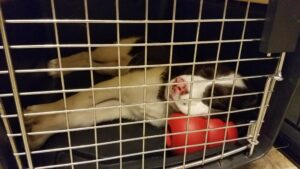
 Most crate training fails because of the owner. Not the dog. The dog has no agenda, no opinions about interior design, and no emotional investment in whether the crate door is open or closed. You are the variable. Your inconsistency, your guilt, your impulse to comfort a crying puppy at 2 a.m., your habit of letting him out the moment he vocalizes: these are the reasons it goes wrong. I am not saying that to shame you. I am saying it because it is a diagnosis, and a diagnosis is useful. Once you understand that your responses shape every behavior your puppy will develop, you can start making deliberate choices instead of reactive ones. The crate is a tool. Like every tool, it only works when used correctly. Here is how to use it correctly.
The Crate Is Not a Cage
Stop thinking of it that way. A cage implies punishment. The crate is the opposite. It is a den, a defined space that belongs to your dog, where the rules are clear and the expectations are consistent. Puppies of many canid species slept in dirt and rocks before they discovered couches, which is a privilege, not a right. Your dog is not being deprived when he is crated. He is being given structure. Structure is what allows him to learn, to settle, and eventually to earn the freedom that you want to give him. The crate is the foundation. Everything else gets built on top of it.
The Right Crate
Use an airline-style crate. Full stop. Wire crates carry injury risks: feet, jaws, and collars can catch in the bars. I do not recommend them and I do not use them. Airline-style crates are solid, enclosed on three sides, and give the dog a genuine sense of being in a contained space. That matters for settling. If you want a crate with a built-in separator so you can adjust the interior size as your puppy grows, the only airline crate I recommend by name is the Ruffland. It is well-constructed, durable, and designed to keep a dog safe. Size the crate correctly. Your dog should be able to stand up without crouching, turn around without contorting, and lie down fully stretched. That is it. Bigger is not better. A puppy with too much room will designate a corner for elimination. Give him exactly what he needs, nothing more.
Bedding and What Goes In
No bedding. This is not primarily about chewing risk, though that is real. Bedding encourages the dog to be dirty. A puppy who has something soft and absorbent to soil will use it. A puppy on a clean, bare floor of a crate has far more motivation to hold it. Keep it clean and bare. The one exception: a Snuggle Puppy, or an article of fabric from the breeder that carries the scent of the dam and littermates, may be used as a transitional artifact to help a young puppy settle into a new environment. This is about scent and comfort during the adjustment period. Once the puppy has settled, it comes out. It is not a permanent fixture. For something to chew, antlers are excellent. They are texturally different from man-made materials, good for keeping teeth clean, and outstanding stress relievers for teething puppies. Products made of manufactured materials are a mistake. Cloth toys, fabric, rubber, and rawhide all resemble common household objects in scent and texture. Giving your puppy those things to chew in his crate is an endorsement that your shoes, furniture, and carpet are appropriate targets too. Do not do it. No puzzle feeders, no animated toys. Keep it simple.
Where to Put the Crate
Centrally located in the home, in a moderately high-traffic area. Not a back bedroom, not a utility room, not somewhere quiet and isolated. Your puppy needs to see and hear the routine daily activities of your household from his crate. This is how he learns the rhythms of your life, what is normal, what is not, and what to expect next. Pattern learning happens through exposure. A puppy tucked away in a quiet room is learning nothing except that being alone is unsettling. Put the crate where life happens. There is time to adjust placement later, as he matures.
Before Your Puppy Comes Home
Set the crate up before your puppy arrives. Have a plan. The moment he comes through the door, he is already on the clock. Take him outside immediately, through the same door, to the same spot, every time. Get him started on that habit from hour one. Do not let him come inside and then figure out where to go. Puppies are elimination machines. They go after sleeping, after eating, after playing, and sometimes in between all of those. Assume he needs to go out. Be right. Reward him when you are. The outside ritual begins before he ever sees the inside of the crate.
Introducing the Crate
Invite, never force. Give your puppy the opportunity to explore the crate on his own terms. Use food. If he is hungry, invite him in with a bit of food and let him investigate. Reward him for entering on his own. Do not push him, drag him, or physically place him in against his resistance. You are building an association, and that association needs to be positive from the first moment. From day one, meals are fed in the crate with the door closed. This is not negotiable. The door does not stay open once the puppy is in. The crate is where he eats. The crate is where he rests. That is what it is. Period. Consistency on this point in the first days shapes every behavior that follows. When he vocalizes, do not go to him. Do not comfort him. Do not negotiate. If you are satisfied his needs are met, give a firm “Quiet!” from a distance. If he settles, respond with a soft “Thank you.” That is the exchange. If he thinks for a minute that vocalizing will bring you to him, he will persist until you give in. Do not give in. Doing so does not comfort him. It teaches him that noise produces results, and it lays the groundwork for anxious, needy behavior that will be far more difficult to undo later.
Building Duration
Start with short crating intervals and build incrementally. Do not try to jump to four hours on day two. Watch the dog. Restlessness, circling, and persistent sniffing are your behavioral cues that he needs to go out. Learn to read them before he has an accident that confirms them. The timing framework from housebreaking applies directly here: take him out after every nap, after every feeding, after every play session, and roughly every 30 to 40 minutes when he is active. Young puppies, particularly those under 12 to 14 weeks, are not reliably clean in their crates overnight. Be prepared to get up and take him out. It is inconvenient. It is also how you prevent a dog who grows up to be dirty in his crate and impossible to housebreak. Make the investment now. It is considerably smaller than the one you make later if you skip it.
The Exit Matters as Much as the Entry
The moment you open that crate door is as important as everything that came before it. A puppy who blasts out of the crate in a frenzy, bouncing off you and everything in the room, is not a happy puppy demonstrating enthusiasm. That is arousal, and arousal at exit teaches the dog that the crate is a compressed spring, and release is an explosion. You do not want that pattern. The door does not open for a dog who is throwing himself at it, vocalizing, or otherwise demanding to be let out. A dog who is demanding release stays confined. A dog who settles earns his exit. You decide when the door opens. Not the dog. When you do open it, keep the energy low. No big greeting, no encouraging the frenzy. Take him straight outside on leash, calmly and directly, to the potty spot. This is not the moment for celebration. That comes after he has done his business outside, where you want it. The routine is clean, predictable, and yours to control.
One of the most common complaints I hear from dog owners is exactly what happens at that crate door: the dog erupts, the owner responds, and the pattern locks in. I have spent time at working dog seminars this season watching handlers struggle with the same problem at a higher level, and the root cause is identical whether the dog is a sporting breed or a family companion. Arousal at exit starts before the door opens. It starts the moment the dog begins anticipating release, and if you open that door while he is in a heightened state, you have reinforced the arousal, not the calm. The principle is simple: demand exit, remain confined. Settle faster, experience freedom faster. This is how you build self-control, and self-control is what makes every other aspect of training possible. The working dog handler needs focus and stamina in the field. The companion dog owner does not want to be knocked over every time the crate opens. The goal is the same. Go slow. Require calm. Open the door on your terms.
Supervision When Not Crated
When your puppy is not in the crate, he is on a leash with a supervising human. This is not optional. This is the other half of the system. Crate or supervised freedom. There is no third option. Unsupervised freedom before housebreaking is solid is how accidents happen, how bad habits form, and how dogs learn to treat your home as a toilet and your belongings as chew toys. The leash keeps him in your orbit. You cannot supervise what you cannot see, and you cannot correct what you did not witness.
Crate Training and Housebreaking Are the Same Project
They are not two separate curricula. They are one. The principle is identical: when you cannot supervise your dog, you must confine him. Everything flows from that. You can read more in the complete guide to housebreaking a dog.
Control access to food and water. Input equals output. Timed, scheduled feedings let you control when your dog needs to relieve himself. A dog allowed to graze freely throughout the day will need to eliminate constantly, at unpredictable intervals, and management becomes impossible. Feed on a schedule. Pick up the bowl. Control the timing. Go outside with your dog. Every time. You cannot reward or reinforce behavior you are not there to witness. If you send him out alone and assume he went, you have set him up to fail. He may have been distracted. He may have forgotten why he was out there.
Accompany him, keep him on leash, keep him focused on the job, and be there to reinforce it when he does it right. If he has an accident inside, do not punish him after the fact. There is no reason and no meaning in it. It only fosters a lack of trust. Ask yourself the honest question: was he supervised? Was he given adequate opportunity? Was he confined when he should have been? The accident is information about a gap in your management. Close the gap. Move on. Watch for the signals: sniffing in circles, a tail arch, whining. These are the tells. When you see them, get him outside immediately. Freedom is commensurate with behavior. As the behavior solidifies, the freedom can expand. Not before.
What Crating Has Nothing to Do With
Putting a dog in a crate after a misbehavior is not punishment. I want to be precise about this, because the misunderstanding is nearly universal. Punishment, to function as a consequence, must be immediate, relevant, and comprehensible to the dog. It must land at the moment of the behavior, connected directly to what the dog is doing, in a form the dog can interpret and learn from. Placing a dog in a crate several minutes after an incident, after you have already expressed frustration, after you have moved through the room, after the dog has no memory of the triggering behavior, accomplishes exactly nothing. The dog does not connect the crate to the incident. The dog does not learn that the crate is a consequence. The dog does not learn anything useful at all. What you have done is confuse the dog with a human emotional outburst it has no hope of interpreting or benefiting from. Dogs do not understand our emotions. They only respond to them. You have not punished a behavior. You have simply reminded yourself how angry you are, in a way the dog cannot make sense of, and placed that confusion inside the space you are trying to make a safe and neutral one. Do not use the crate as an emotional pressure valve. It is not one. It is a training tool. Treat it as such.
Separation Anxiety and the Crate
Clinical separation anxiety in dogs is rare. That is not my opinion. That is the finding of researchers and the position that dog trainers have maintained consistently: separation anxiety is almost wholly an owner-created sensitivity to departure or abandonment. A study at UC Davis found that separation problems are caused by frustration related to dependency on the owner. Hyper-attachment to the owner was significantly associated with separation anxiety. Extreme following of the owner, departure cue anxiety, excessive greeting: these are the markers. The dog who has been allowed to monopolize your attention, sleep in your bed, follow you from room to room, and be the constant recipient of your affection has been set up for this. You did not intend to create it. But you created it. Prevention is straightforward, and the crate is central to it.
A dog who has been conditioned from puppyhood to spend time alone in his crate, in a calm and matter-of-fact way, is a dog who has learned that alone time is normal. It is not a crisis. It is just part of the day. Beyond crate training, the prevention protocol is this: Do not make a fuss before you leave. No long goodbyes, no emotional departures. Simply go. Do not make a fuss when you return. Go about your business. Control his behavior before you attend to his excitement. Change your departure rituals so the dog is not being cued by the same sequence every time. Carry your keys at random. Wear your jacket in the house. Leave and return multiple times during the day with no particular meaning attached. Practice leaving while you are home. Walk to the mailbox. Go to the garage. Let him be alone for short stretches while you are still on the property.
Do not permit the dog to monopolize your affection. Give the dog his own place to sleep. Not your furniture. Not your bed. Keep feeding schedules, potty breaks, and activity times as consistent as possible. Drug therapy alone is not a solution. Behavior modification is vastly more successful. Drug therapy used alongside behavior modification shows better results in the most resistant cases, but the behavior work has to happen regardless. Prevention is always easier than remediation. Start correctly, and you will not need to remediate.
The Investment That Pays Off
What you allow will continue. That principle governs everything in dog training, and crate training is no exception. Start early. Stay as long as it takes. Provide options. Guide choices. Control outcomes. Reap the benefits. A dog who is correctly crate trained enters willingly, self-enters quietly, remains clean, and signals when he needs to go out. That dog goes on to be a reliably housebroken, trustworthy member of your household. That dog does not end up in a shelter because the housebreaking issue became unbearable. That dog has a future. The work is not complicated. It requires consistency, patience, and the willingness to hold the line when your puppy is telling you, loudly, that he disagrees with your decisions. Hold the line anyway.
If puppy barking in the crate is your current challenge, understand that it fits exactly within this framework: the dog is vocalizing because vocalizing has worked before, or because he has not yet learned that calm behavior is what earns release. Both are solvable with the same consistent approach described here.
Work With Us
If you want to get crate training right from day one, I work with families in person through my puppy training program in Carroll County and with owners anywhere in the world through virtual training from anywhere. The best way to get started is to schedule a consultation so we can talk through where you are and what your puppy needs.