 Between the trainer wars, the online influencer culture, and new legislation further restricting access for dogs in public spaces, dog trainers find themselves under extraordinary scrutiny these days.
I have to say, I am almost embarrassed to admit I train dogs. What used to bring me great pride has become a hotly debated, divisive, contentious topic.
And the stakes for the dog-owning public are not small. The wrong choice does not just waste money. It can make your dog worse.
When Dog Trainers Make the News
Dog training has made the news recently, and not in any positive way.
A training franchise in Tennessee was under fire for the starvation of a client dog left in their care. Cruelty charges were filed.
A franchisee from the same chain in Nevada was videotaped threatening a Doberman with a baseball bat. The franchise withdrew his license. He was largely unapologetic. The franchisee was never officially charged.
In New York, an individual was recorded brutalizing a small dog with an electronic collar while the dog lay on a cot. The commentary on the video made clear this person had absolutely no idea of what they were doing or why. The “training” they received was woefully inadequate.
People with fewer years in this industry than the age of my last set of tennis shoes are charging extraordinary sums for less than adequate work, based on untruths, half-truths, and outright lies.
Why Dog Training Is Unregulated
There is currently no legislation governing the dog training industry on a local, state, or national level. Anyone can claim to be a dog trainer. Anyone.
There are organizations, membership-driven, certification-granting organizations, but membership and certification simply mean the applicant met that organization’s own criteria. The best organizations require a genuine demonstration of skill through rigorous testing by people who know what they are looking at. Others do not. A certificate of completion is not the same as a measure of competence.
The only reliable measure is this: watch the trainer work dogs. Not the slick website, nor the flashy YouTube videos. Not the certifications listed after their name. Not the testimonials. Watch them work dogs.
The best way to measure a dog trainer’s skill is to watch him work some dogs. Period.
What Credentials Actually Mean
N.A.D.O.I., the National Association of Dog Obedience Instructors, is the oldest organization of its kind in the world. Membership is not assured. Each applicant undergoes a rigorous evaluation that genuinely measures competence with dogs and the ability to instruct others.
That matters because it is not a self-administered test. It is not a weekend course. It is not a fee-for-membership credential. Obtaining membership is not guaranteed; each applicant must demonstrate proficiency in dog training and their ability to effectively instruct others.
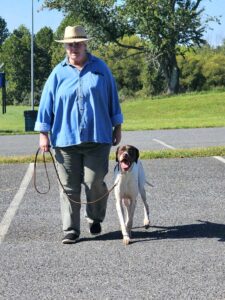
Linda Kaim of Lionheart K9 is the only N.A.D.O.I. certified trainer in Carroll County, Maryland.
What to Ask Before You Hire
A wise colleague, gone now, but his thinking was sound, put together a professional ethics framework that translates directly into the questions every dog owner should ask before hiring a trainer. Adapted here for owners choosing who to trust with their dog.
Do they carry liability insurance? A professional trainer working in your home with your dog should carry at minimum $1 million in liability coverage, including care, custody, and control. If they cannot answer this question directly, that is your answer.
Do they guarantee results? A trainer who guarantees outcomes does not understand what thorough behavioral change actually requires. If you think you can assess whether you have truly fixed a serious behavior problem in less than nine to twelve months, under greater provocation than the dog has ever encountered, you do not understand what thorough dog learning is. Honest trainers do not guarantee. They commit.
Will they train your dog, or just manage your dog? There is a difference between a trainer who teaches a dog to think and respond, and one who manages behavior through tools alone. The goal is a dog that performs reliably because it understands, not one that complies only when the equipment is on, with constant verbal reminders or other external influences to hold it in place.
Can they walk you through the fix without touching the leash? A trainer’s job is to fix the problem and then teach the owner to maintain it. If they cannot walk you through the process and have you execute it yourself, the training does not transfer. A trainer who always has to hold the leash has a communication problem.
Do they understand that obedience is the foundation for everything? If a trainer thinks they are going to modify a dog’s behavior without training the dog in some form of foundational obedience, they have been reading too many academic articles and not doing enough real work. Obedience foundation helps facilitate behavior modification. One cannot be cleaved from the other.
Will they show you their work? Any competent professional should welcome your observation. They should have nothing to hide. Ask to watch them work before you commit. Social media is great, but it is also heavily curated to reflect an image over anything tangible. Ask to sit in on a lesson, or meet somewhere publicly.
The Problem with Modern Trainer Culture
Today, everyone is an “expert” who specializes in aggression, or anxiety, or ‘reactivity’. They claim things that very few are actually able to deliver.
What is lacking in many trainers entering the field today is the same natural curiosity that motivated those of us who pursued this as a vocation. Instead, many count on the general naivete of the dog-owning public and hire influencers to sell a product they cannot fulfill. The cult of personality produces hundreds of new entries into the race for the next celebrity trainer, and it costs dogs, and it costs trust.
People admire a pleasant, mannerly companion when they see one. Sadly, it is so rare that they actually get the opportunity to see that dog. What they usually see are the pulling, yapping, lunging misfits at the end of a Flexi-lead.
People need to know their trainer is capable. People need to know their dog is going to be made better, not worse.
What Experienced Training Actually Looks Like
Since the advent of dog training as a profession, trainers did not specialize. We trained the dog we were handed. If a client had a dog that ran away, chewed the furniture, herded the children, or chased the mail truck, we trained that dog to a degree of reliability that solved the problem.
We didn’t make excuses. We didn’t misrepresent our skill level. We stayed committed to the work until the job was done, or we had the wherewithal to decline the client.
We taught owners to be proactive. How to cultivate the relationship. To appreciate their dog’s nature instead of infantilizing it or making excuses for it.
Trust me when I say there is very little that training cannot accomplish.
For me, what I did all those decades ago is largely the same. We start at the beginning. We work through the natural progression known as the middle, and we follow it to a logical, productive conclusion.
If You Are Looking for a Trainer in Carroll County
Lionheart K9 offers private, in-home dog and puppy training for Carroll County, Maryland residents. Sessions are conducted in your home, because that is where your dog actually lives, and where the behavior actually happens.
Virtual dog training is available for clients anywhere in the world. Same one-on-one coaching, flexible scheduling.
Call 717-880-4751 or book a free 30-minute consultation.